.png)
PATH Funded
Projects for Assistance in Transition from Homelessness (PATH) programs are federally funded initiatives that provide outreach and supportive services to individuals experiencing homelessness or those at imminent risk of homelessness who have serious mental illness or co-occurring mental health and substance use disorders. Within HMIS, PATH-funded programs are used to document client engagement, services provided, referrals, and housing outcomes in accordance with federal reporting requirements.
PATH programs typically focus on identifying and engaging individuals who are disconnected from traditional services and helping them access behavioral health treatment, housing resources, public benefits, healthcare, and other community supports. HMIS serves as the system of record for capturing client interactions and measuring program performance, service delivery, and outcomes.
By maintaining complete and accurate HMIS records, PATH providers can better coordinate care, improve service delivery, and ensure compliance with federal reporting standards while supporting individuals with serious mental illness in achieving housing stability and improved well-being.
There are two program types for PATH funded programs:
- PATH Street Outreach - provides outreach and engagement to clients living in places not meant for human habitation. These PATH activities are designed to meet the immediate needs of unsheltered homeless persons by connecting them with emergency shelter, housing, and/or critical health services.
- PATH Supportive Services - provides outreach and engagement to clients who are residing in emergency shelter or are doubled-up in housing and are at-risk of homelessness.
PATH Specific Data Elements
In addition to the HMIS Core Data Elements, PATH grantees are required to collect the following data elements.
| Data Element | Recorded |
| Current Living Situation | Recorded at first contact (program enrollment date) and every contact thereafter |
| Date of Engagement | Recorded the date client consents to participate in program |
| Date of Status Determination | Recoded when the client is both "engaged" and eligibility determined for PATH |
| Client Became Enrolled in PATH | Required yes/no question associated with the Date of Status Determination |
| Connection with SOAR | Response recorded on enrollment and updated on status update or exit if changes |
PATH Data Collection Workflow
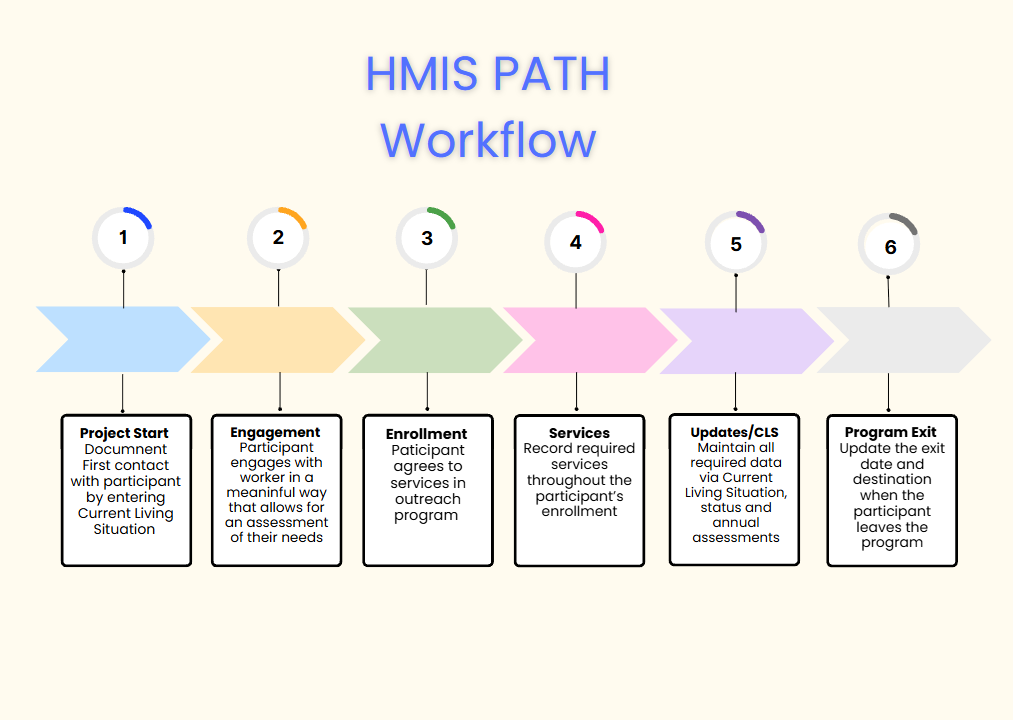
PATH data collection workflow is designed to support the interactions and development of relationships with clients over time. As such, HMIS data quality does not begin until the Date of Engagement (data element 4.13), defined as the point at which an interactive client relationship results in a deliberate client assessment. The date of enrollment may be on or after the Project Start Date (data element 3.10) and on or after the Date of Engagement. It is possible that project start, engagement, enrollment, and project exit may all occur during a single contact at a single point in time.
However, it is much more likely that Project Start Date will be followed by multiple contacts, recorded using Current Living Situation, prior to Date of Engagement. The chart below illustrates the necessary sequence of data collection, which may happen in a day, or over a number of days, weeks, or even months, depending on the client’s willingness to engage with the PATH project, eligibility for PATH-funded services and referrals, and continued connection to the project.
Contacts
Contact
- Interaction between a PATH-funded worker and an individual who is potentially PATH eligible or enrolled in PATH.
- PATH Program components must record every contact made with each client in the HMIS.
Contact Activities
- Conversation between the PATH-funded worker and the client about the client's well-being or needs.
- Office visit to discuss their housing plan
- Referral to another community service.
Recording a Contact
- A contact must be recorded anytime a client is met, including during "in-reach" or when the client is contacted in another service setting.
- Contacts must also be recorded if an engagement date or project start date is recorded on the same day.
Current Living Situation
All PATH Program components must record every contact made with each client in the HMIS. For PATH, a contact is defined as an interaction between a PATH-funded worker or workers and an individual who is potentially PATH eligible or enrolled in PATH. Contacts may include activities such as a conversation between the PATH-funded worker and the client about the client's well-being or needs, an office visit to discuss their housing plan, or a referral to another community service. A contact must be recorded anytime a client is med, including during "in-reach" or when the client is contacted in another service setting. Contacts must also be recorded if an engagement date or project start date is recorded on the same day.
A Current Living Situation must be recorded:
- At the first contact/project start
- At every subsequent contact
- When the client is contacted in another service setting
- When the client is contacted during in-reach
- When the Project Start Date and Date of Engagement occur on the same day
Referrals and Services
Referrals
- Used to document when a client is connected to outside services or community resources that may support housing stability, health, or overall well-being.
- Accurate data helps track client connections to care and demonstrates PATH program outcomes.
Services
- Used to document supportive services provided directly to clients.
- Accurate service documentation helps track client engagement, service delivery, and program outcomes.
Program Exits
PATH program exits are used to document when a client is no longer receiving services through the PATH program. Accurate exit information helps maintain data quality, supports reporting requirements, and ensures client records reflect current program participation.
Common Exits
- Successfully connected to ongoing services
- Obtained housing
- Cannot be contacted or located
- Declined further services
- Moved out of service area
- Program participation ended
PATH Annual Report
The PATH Annual Report is used to:
- Measure program performance and client engagement
- Track services and referrals provided
- Demonstrate outcomes such as housing connections and access to care
- Ensure compliance with federal reporting requirements
- Support funding and program planning efforts
The report includes:
- Number of clients contacted through outreach
- Number of clients enrolled in PATH services
- Demographic information
- Services provided
- Referrals made and outcomes
- Housing status and client outcomes at program exit
Resources
- New England PATH HMIS Workflow Guide (PDF)
- PATH Annual Report - New England HMIS Report Library
Forms
Looking for PATH forms for your state? Click the link: New England Forms
Copyright 2026 Institute for Community Alliances. All rights reserved.